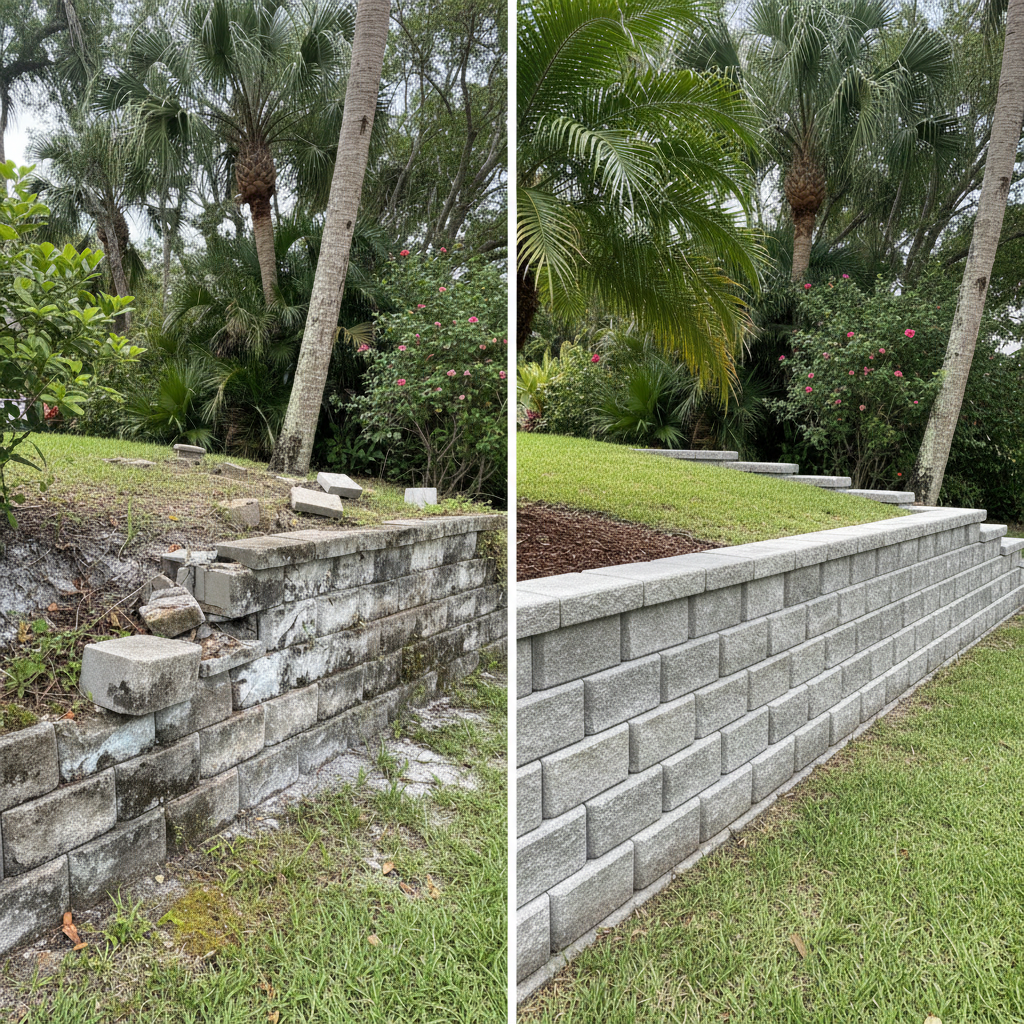
So, you're thinking about putting in a retaining wall, huh? Maybe you've got a slope in your yard that's washing away, or you're trying to create a level area for a patio. Whatever the reason, you've probably heard a couple of terms thrown around: 'engineered wall' and 'gravity wall.' What's the real difference, and which one's right for your St. Pete home?
Gravity Walls: Simple & Sturdy (Sometimes)
Let's start with gravity walls. These are pretty much what they sound like. They rely on their own weight and the friction between the blocks or materials to hold back the soil. Think about those stacked concrete blocks you see in a lot of older yards, or even dry-stacked stone walls. The idea is that the sheer mass of the wall is enough to resist the pressure from the dirt behind it.
For small, non-critical applications, they can be a decent option. If you're just building a decorative planter box that's a foot or two high, or maybe terracing a very gentle slope that doesn't see a lot of water runoff, a gravity wall might do the trick. They're generally quicker to install and often cost less upfront because you don't always need a structural engineer to sign off on the design. You can even DIY some smaller ones if you're handy.
But here's the catch, especially here in Florida. Our sandy soils, heavy rain during hurricane season, and the general lack of solid bedrock close to the surface mean that a simple gravity wall can quickly become a problem. That pressure from saturated soil can be immense. I've seen plenty of gravity walls in places like Snell Isle or Shore Acres that just didn't hold up. They start leaning, bulging, or even collapsing entirely. Once that happens, you're not just fixing a wall; you're often dealing with eroded soil, damaged landscaping, and a much bigger mess than you started with.
Engineered Walls: Built to Last
Now, engineered walls are a whole different ballgame. These are designed by a structural engineer – like us here at Skyline Structural Solutions – to specifically handle the forces at play. They don't just rely on their own weight. Instead, they incorporate things like geogrid reinforcement, which are layers of high-strength polymer fabric embedded in the soil behind the wall. These grids tie the wall face back into the soil mass, creating a much larger, more stable structure that acts as one unit.
You'll also often see things like proper drainage systems built behind engineered walls. This is crucial in St. Pete. When heavy rains hit, water can build up behind a wall, increasing the pressure exponentially. An engineered wall design will account for this, often specifying perforated pipes and gravel backfill to direct water away, preventing hydrostatic pressure from building up and pushing the wall over.
The foundations for engineered walls are also typically more robust, often deeper and wider, sometimes even including a concrete footing with rebar. This ensures the wall has a solid base that won't settle unevenly or shift over time.
Cost, Durability, Maintenance, & Appearance
- Cost: Upfront, an engineered wall will almost always cost more. You're paying for the engineering design, the specialized materials like geogrid, and often a more involved installation process. But think of it as an investment. A properly engineered wall is a one-and-done deal. A failing gravity wall will cost you more in repairs and re-dos down the line.
- Durability: No contest here. Engineered walls are designed for longevity and stability, especially in challenging conditions like ours. They're built to withstand the forces of soil, water, and even minor seismic activity (though that's less of a concern here).
- Maintenance: Once an engineered wall is properly installed, maintenance is minimal. Keep the drainage clear, and that's usually it. Gravity walls, especially if they're not quite up to the task, might require more frequent monitoring for shifting or bulging.
- Appearance: Both types of walls can be built with a variety of materials – concrete blocks, natural stone, timber. So, aesthetically, you can achieve similar looks. The difference is that an engineered wall will maintain that look because it's not going to lean or sag.
My Recommendation for St. Pete Homeowners
Look, I've been doing this a long time, and I've seen the good, the bad, and the ugly. For almost any retaining wall over, say, two feet high, or any wall that's holding back a significant amount of soil, or if it's near a structure or property line, you absolutely need an engineered design. Period.
The peace of mind knowing that your wall is built to last, designed by professionals to handle our specific Florida conditions – the heavy rains, the sandy soil, the potential for high water tables – is worth every penny. You don't want to cut corners when it comes to structural integrity. If you're unsure, just give us a call. We can take a look at your property and give you an honest assessment of what you need.